
| Hallmark Number | Approximate Karat | Pure Gold Content | Meaning |
|---|---|---|---|
| 375 | 9K | 37.5% | 9-karat gold |
| 417 | 10K | 41.7% | 10-karat gold |
| 585 | 14K | 58.5% | 14-karat gold |
| 750 | 18K | 75% | 18-karat gold |
| 916 | 22K | 91.6% | 22-karat gold |
| 999 | 24K | 99.9% | Nearly pure gold |
Numbers like 375, 417, 585, 750, 916, and 999 typically express gold purity out of a thousand parts. These figures — along with other marks stamped into jewelry are widely known as a hallmark.
What Do Gold Hallmark Numbers Mean?
Compare common gold fineness marks and see approximately how much pure gold each alloy contains.
37.5% Pure Gold
41.7% Pure Gold
58.5% Pure Gold
75% Pure Gold
91.6% Pure Gold
99.9% Pure Gold
A higher fineness number means a higher proportion of pure gold in the alloy.
Need Help Verifying Your Gold?
Authenticity matters. Whether you have questions about jewelry hallmarks, or you’re ready to shop for 100% genuine, certified custom gold jewelry, the Gold American team is here for you.
We guarantee the purity and quality of every piece we craft.
What Is a Gold Hallmark?
What Should You Look for on Gold Jewelry?
A hallmark may contain more than one piece of information. Check each element rather than relying on a single number.
Purity Number
Shows fineness in parts per thousand.
Karat Mark
Expresses gold purity using the karat system.
Maker’s Mark
May identify the maker or responsible sponsor.
Assay Office Mark
Used in some official hallmarking systems.
A gold hallmark is a set of numbers, letters, or symbols stamped into a piece of jewelry to tell the buyer something about the metal. The most important piece of information a hallmark usually reveals is the karat, or purity, of the gold. For example, if a ring is stamped with the number 750, that number generally points to 18-karat gold at 75% purity. In the same way, a 585 mark is usually associated with 14-karat gold.
In some official hallmarking systems, the purity number isn’t the only thing stamped on a piece — additional marks may identify the maker, the assay office, or the quality-control system involved. The core purpose of these marks is to give buyers information they can actually verify about the metal’s composition and purity. In the UK, GOV.UK explains hallmarking this way:
The purpose of hallmarking is to protect buyers of precious metal items against fraud. The hallmark is a mark which shows that the item has been independently tested and verified as matching its description, and conforming to all legal standards of purity or fineness of the metal.
What Information Do Gold Jewelry Hallmarks Show?
The Anatomy of a Complete Hallmark
Initials or symbols identifying the manufacturer or brand who made the piece.
The millesimal fineness number indicating the exact percentage of pure gold.
A unique symbol showing which official office tested and verified the metal’s purity.
Gold jewelry hallmarks can carry different types of information, and exactly what’s stamped depends on the country, the hallmarking system, and the type of piece. The most common things you’ll find on a hallmark include:
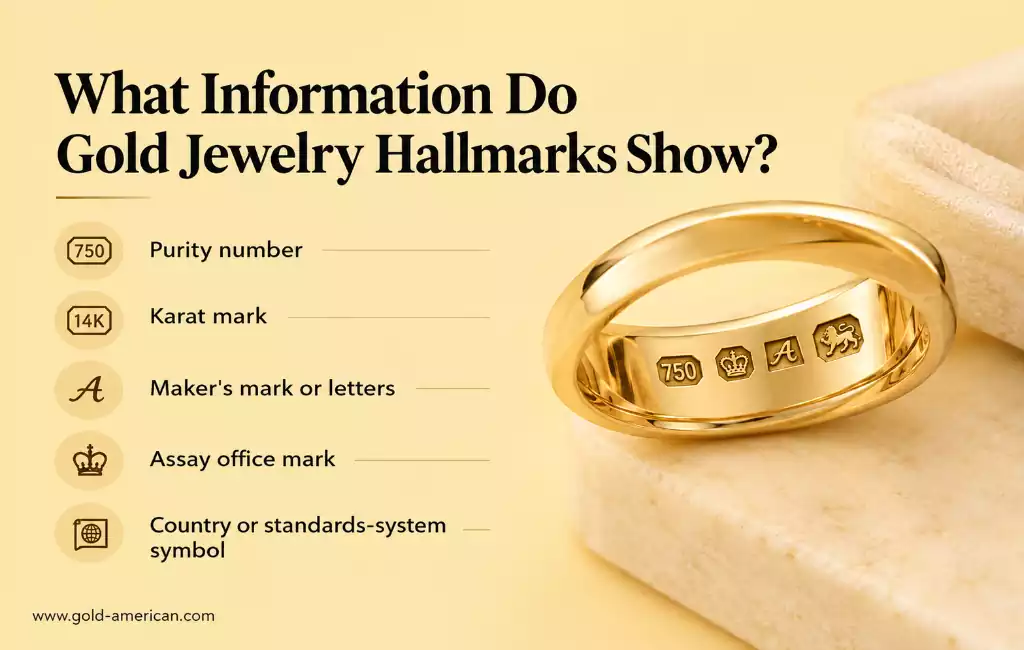
- Purity number: such as 375, 585, or 750
- Karat mark: such as 9K, 14K, 18K, or 22K
- Maker’s mark or letters: identifying the manufacturer or the party responsible for registering the piece
- Assay office mark: used in some official systems
- Country or standards-system symbol: depending on where the piece was made or sold
Where the mark is stamped depends on the type of jewelry. You might find a hallmark inside a ring’s band, on the back of a pendant, on a necklace clasp, inside an earring, or on some other small, easy-to-miss part of the piece. Because these areas are so small, some marks are tiny enough that you’ll need a magnifying glass and good lighting to read them.









What Do the Numbers on Gold Actually Mean?
Gold Purity Levels Explained
* The grey area represents other alloyed metals (like silver, copper, or zinc) added for strength.
Numbers stamped on gold generally refer to the proportion of pure gold in the alloy, expressed out of 1,000 parts. As a simple rule of thumb, divide the number by 10 to get the approximate gold percentage — though for a number like 999, that essentially represents 99.9% purity.
The fineness is indicated by a millesimal number
(parts per thousand) and the metal type is indicated by the shape of the surround.
(Source: GOV.UK guidance PDF)
That said, you shouldn’t judge a piece’s authenticity from a single number alone, since marking systems vary between countries and markets. If you’re researching markings on gold, the numbers in the table above are the ones you’ll run into most often. Worth noting: 14K and 585 can refer to the same purity level in many markets, but how the mark is applied — and the legal requirements behind it — isn’t identical everywhere.
Hallmark numbers become especially useful when you’re comparing different gold purities. For example, 417 generally corresponds to 10K gold, while 585 is commonly associated with 14K gold. If you’re deciding between these two options, our 10K vs 14K gold comparison explains the differences in purity, durability, and everyday wear.
How to Read Gold Hallmarks
Spotting a single number on a piece of jewelry isn’t enough on its own. It’s worth working through these steps in order:
- Locate the mark. Check inside the ring band, the back of a pendant, the clasp of a necklace, or the inner part of a bracelet.
- Read the purity number. Numbers like 585 or 750 usually indicate the purity.
- Check the surrounding letters and symbols. There may be additional information about the maker or the hallmarking system.
- Compare the mark against the product details. The karat, the listed specifications, and the seller’s information should all line up.
- When in doubt, get it professionally checked. A stamped mark alone isn’t always enough to prove authenticity.




Karat vs. Hallmark: What’s the Difference?
585 vs. 750 Gold at a Glance
Two of the most common gold fineness marks compared.
Karat (K) is a way of expressing gold purity, while a hallmark refers to the full set of marks stamped into a piece. For example:
- 14K means 14-karat gold
- 18K means 18-karat gold
- 585 is usually equivalent to 14K
- 750 is usually equivalent to 18K
So when you see the number 750 on a ring, that number is a fineness mark. K, on the other hand, expresses the karat system directly.
If you come across an 18K or K18 mark instead of a millesimal number like 750, the two markings can point to the same general gold-purity level but use different notation systems. You can read our guide on what K18 means on jewelry for a closer look at how the 18K marking is used and interpreted.
Why Does a Gold Hallmark Matter?
Checking a hallmark before buying can give you more information about a piece — especially useful when several similar-looking items actually differ in purity. Three key reasons to check the hallmark:
- Understanding purity: the stamped number can indicate the karat or purity percentage
- Comparing products: makes it easier to compare pieces of different karats
- Verifying product information: a hallmark can be cross-checked against specs, the invoice, and seller details
When buying gold, appearance alone isn’t the only thing that matters — technical specs and material/purity information matter just as much.
Can a Hallmark Prove Gold Is Genuine?
A hallmark can be an important signal for checking gold, but on its own it isn’t absolute proof of authenticity. To answer the question of what is hallmark gold, you need to distinguish between a purity mark and proof of genuineness. A number like 585 tells you about the claimed purity of a piece, but for real certainty, other factors need checking too. Before buying, look at these alongside the hallmark:
- Seller credibility
- Invoice and purchase details
- The listed product specifications
- The country or hallmarking system used
- The letters and symbols accompanying the number
- Professional verification or accredited testing, if needed
Don’t treat 585 as conclusive proof of authenticity just because it’s stamped there — plated pieces or items with unofficial marks can look similar.
A hallmark is useful evidence, but it should not be treated as the only test of authenticity. If you want to go beyond the stamped number, see our guide on how to tell if gold is real or fake, which covers additional signs and verification methods to consider before relying on a mark alone.








Gold Hallmarks Around the World
Hallmarking systems aren’t identical across countries. One country might rely solely on purity numbers, while another uses a fuller set of official marks covering the maker, purity, and assay office. In the UK hallmarking system, for instance, several marks typically appear together, including:
- Maker’s or Sponsor’s Mark
- Fineness Mark
- Assay Office Mark
According to mantons.uk:
A complete hallmark consists of 3 compulsory marks. If an item has not been stamped or marked with these 3 markings then it has not been properly hallmarked. All 3 marks must be present.
For this reason, when buying imported gold, it’s worth learning about the country of origin’s marking system rather than relying on the number alone.
Common Mistakes When Checking Gold Marks
Checking gold jewelry hallmarks is far more useful when you avoid these common mistakes:
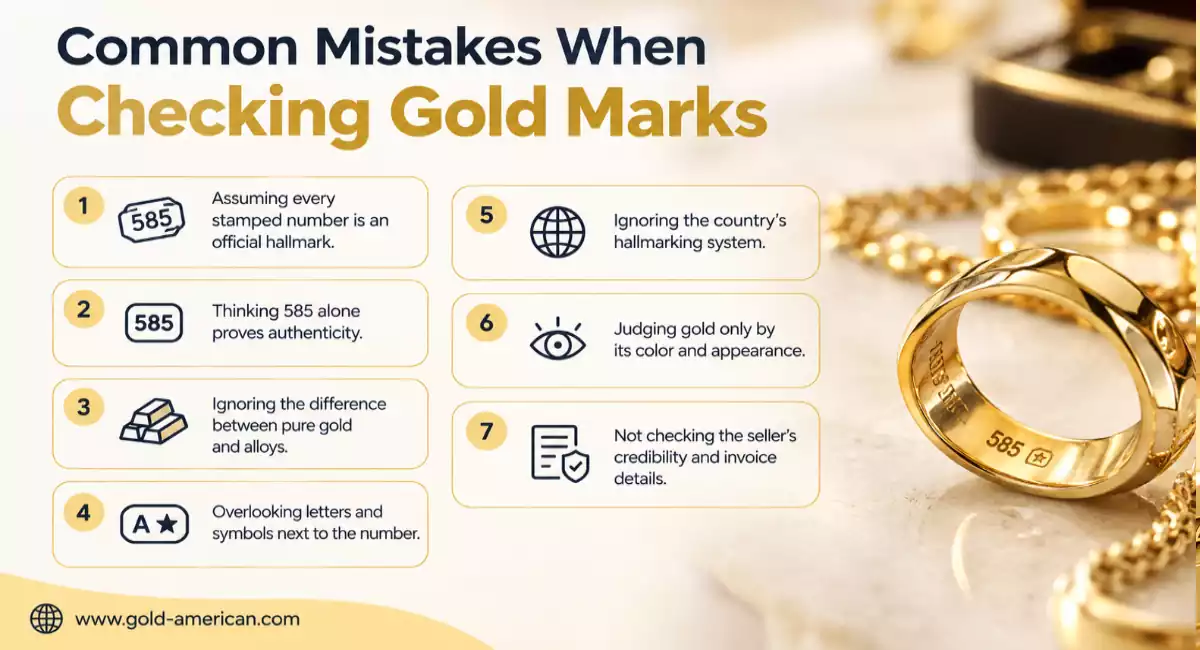
- Assuming every number stamped on gold is necessarily an official hallmark
- Thinking the number 585 alone proves authenticity
- Ignoring the difference between pure gold and alloyed gold
- Skipping the letters and symbols next to the number
- Not considering the manufacturing country’s hallmarking system
- Judging a piece based only on color and appearance
- Ignoring seller credibility and invoice details
Quick Checklist for Checking a Gold Hallmark
How to Check a Gold Hallmark
Use this quick sequence before relying on a stamped number.
Locate
Find the stamp
Read
Check the number
Inspect
Look for symbols
Compare
Match product specs
Verify
Get expert help if needed
- Locate where the mark is stamped
- Read the purity number
- Match the number against the product’s stated karat
- Check the surrounding letters and symbols
- Consider the country or marking system
- Compare product details against the invoice
- Get professional verification if you’re unsure
Hallmarks and Jewelry Materials at Gold American
Here’s how three common materials relate to hallmarks:
| Material | Hallmark / Related Mark | Relationship to Hallmark |
|---|---|---|
| 14K Solid Gold | 585 / 14K | The number 585 represents roughly 58.5% pure gold and is commonly linked to 14-karat gold. |
| Vermeil | 925 + gold plating | Vermeil’s base is sterling silver, plated with gold — so the 925 mark refers to the base silver, not to the whole piece being 14-karat gold. |
| Sterling Silver 925 | 925 | The number 925 shows the alloy contains 925 parts silver per 1,000, or 92.5% silver. |
Important distinction: for 14K solid gold, the hallmark can be tied directly to the gold’s purity. For vermeil, though, the 925 mark refers to the base metal, silver, with gold only as a surface layer. These three categories shouldn’t be lumped together when it comes to hallmarking.
Gold vermeil should be interpreted differently from solid gold when reading jewelry marks. A 925 stamp on vermeil refers to the sterling-silver base, while the gold forms the plated outer layer. You can explore our gold vermeil jewelry collection to see how this material differs from solid-gold pieces.
Don’t Confuse These Jewelry Marks
The same-looking number can mean very different things depending on the underlying material.
585 indicates approximately 58.5% pure gold.
925 refers to the sterling-silver base beneath the gold layer.
925 indicates an alloy containing 92.5% silver.
Gold American Products
Once you understand what the hallmarks for gold are, the next step is choosing jewelry with clear, well-documented product information. At Gold American, you can browse several categories of gold jewelry, including:
| Product Category | Best For |
|---|---|
| Gold Necklaces | Everyday wear and varied styling |
| Gold Name Necklace | Personalized designs |
| Gold Bracelets | Everyday wear or gifting |
| Gold Earrings | Different styles for different looks |
| Custom Rings | Designs tailored to personal taste |
| Gold Pendants | Pairing with chains for varied styles |
When choosing any piece, check the karat, product specs, and seller-provided details alongside the design itself.
Because a 925 mark can appear on silver-based jewelry that also has a gold-colored surface, it’s important to separate the base metal from the finish. Our guide to gold plated vs sterling silver explains how these materials differ and why their markings should not be interpreted in the same way as solid-gold hallmarks.
A Real Customer Experience with Gold Hallmarks
I once went shopping for gold and honestly didn’t pay any attention to the marks or numbers stamped on the piece — I cared mostly about the look and the design. Later, after learning more about gold hallmarks, I realized those tiny marks actually carry real information about karat and purity. Since that purchase, I always check the hallmark and the piece’s specs before choosing gold — it genuinely became an important lesson in how I shop.
Not Sure About a Gold Mark or Jewelry Material?
Have a question about karat, materials, product specifications, or choosing the right piece? Contact Gold American and we’ll help you find the information you need before ordering.
FAQ: Gold Hallmarks
1. What is a gold hallmark?
A set of numbers, letters, or symbols stamped into jewelry that can indicate purity, the maker, or the metal’s control and identification system.
2. What does 585 on gold mean?
The number 585 usually indicates 58.5% pure gold, equivalent to 14-karat gold.
3. Is 585 real gold?
585 usually points to 14-karat gold, but the number alone doesn’t prove authenticity — it’s worth checking the seller’s information, product specs, and, if needed, professional testing.
4. What does 750 on gold mean?
750 usually means the piece is 75% gold, equivalent to 18K in the karat system.
5. What are the most common gold hallmarks?
The most common numbers are 375, 417, 585, 750, 916, and 999, corresponding respectively to 9K, 10K, 14K, 18K, 22K, and 24K.