

| Jewelry Type | Likelihood of Green Skin | Cause |
|---|---|---|
| 24K gold | Very low | High purity |
| 18K gold | Low to moderate | Alloy metals |
| 14K gold | Depends on the alloy | Metal reaction with sweat and moisture |
| 10K gold | Depends on the alloy | Higher percentage of other metals |
| Gold-plated jewelry | Possible | Plating wearing thin |
| Copper | Possible | Reacts with sweat and moisture |
| Nickel | More linked to skin sensitivity | Known cause of contact dermatitis |
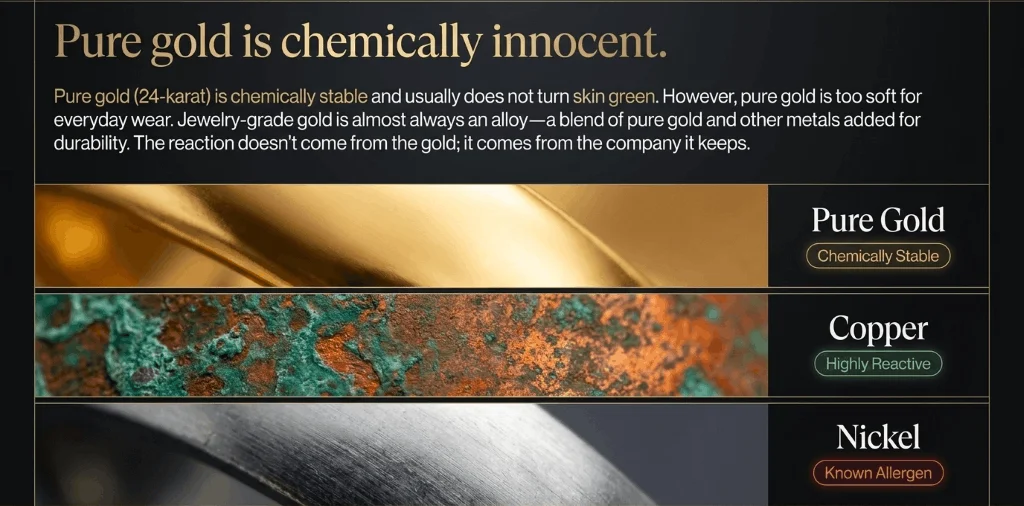
Yes, gold jewelry can sometimes turn skin green — but the gold itself usually isn’t the culprit. That greenish tint typically comes from more reactive metals mixed into the gold alloy, especially copper, which reacts with sweat, moisture, lotion, or other substances on your skin. Pure gold is chemically stable; it’s the alloyed metals that react with your skin and the environment.


My Experience
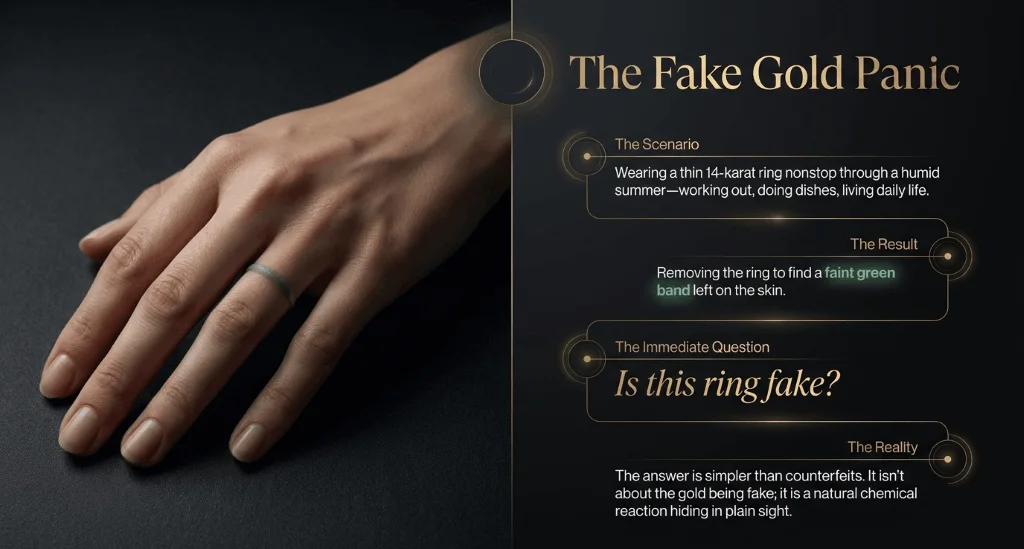
I remember the first time this happened to me clearly. I wore a thin 14-karat ring almost nonstop through one humid summer — during workouts, doing dishes, everywhere. One morning I took the ring off and found a faint green band underneath. My first thought was, “Is this ring fake?” But the answer was simpler than that: it wasn’t about the gold being fake, it was a reaction between sweat and copper. Once I started taking the ring off before the gym and drying my hands properly, the discoloration never came back.
A few key points before we go further:
- Pure gold on its own usually doesn’t turn skin green.
- Jewelry-grade gold is almost always an alloy, not pure gold.
- Copper is one of the main causes of green discoloration.
- Nickel can also be present in some alloys, but it’s linked more to skin sensitivity and allergic reactions than to green staining.
- Gold American jewelry is made without nickel — more on that below, without overselling it.
✨
Tired of Green Marks and Skin Irritation?
Upgrade to jewelry you never have to take off. Protect your skin by choosing our premium, everyday pieces crafted from solid 14K gold that won’t turn your skin green.
Shop Hypoallergenic Personalized Gold Jewelry
✔️ Solid 14K Options
✔️ Safe for Sensitive Skin
Why Does Gold Jewelry Turn Skin Green?
Why Can Gold Jewelry Turn Skin Green?
Gold Purity
Lower karat gold contains more alloy metals that may react.
Moisture & Sweat
Water, sweat, and oils can speed up metal reactions.
Green Mark
Reactive metals may leave a temporary green residue.
Copper in Gold Alloys
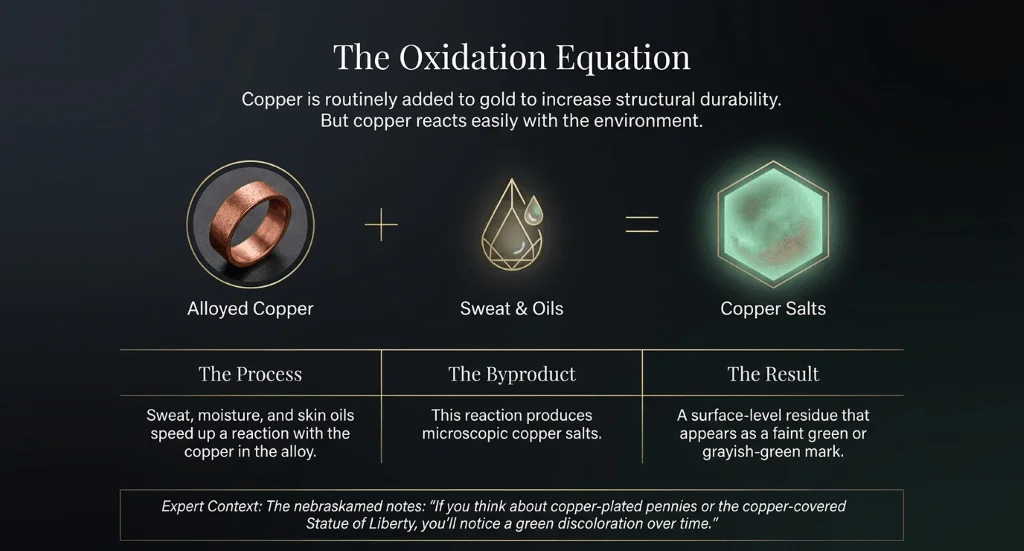
Copper is added to gold to increase durability, since pure gold is too soft for everyday wear. The problem is that copper reacts fairly easily with sweat, moisture, skin oils, lotion, perfume, cosmetics, and even chlorine. That reaction produces small amounts of copper salts, which is what shows up on the skin as a green or grayish-green mark.
Nickel and Skin Reactions
This is where a lot of jewelry articles mix up two very different things. Green skin and allergic reactions are not the same thing, and they don’t come from the same cause. Nickel can be present in some jewelry alloys, and for people sensitive to it, it’s a well-known trigger of allergic contact dermatitis — meaning redness, itching, or a rash, not a green mark. The American Academy of Dermatology notes:
Nickel is one of the most common causes of allergic contact dermatitis: a skin rash or irritation caused by touching an allergen.
Copper is the metal most often behind the green mark, and nickel is the metal most often behind an actual skin reaction. Keeping that distinction straight matters, because it determines what you should actually do about it.
How Does Jewelry Turn Skin Green?
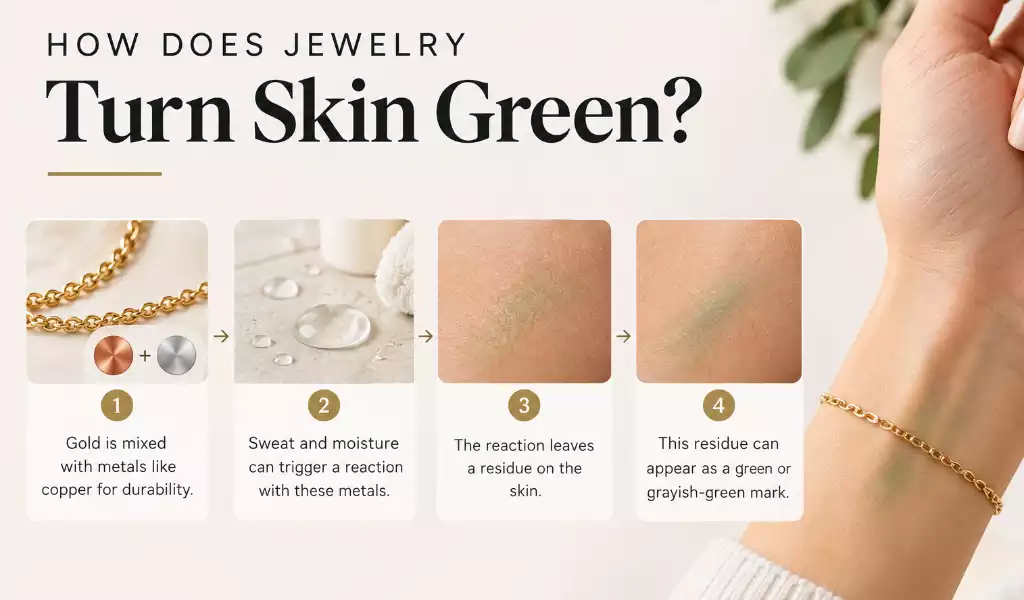
It’s a fairly simple chain reaction:
- Gold is alloyed with other metals to make it durable enough for daily wear.
- Some of those metals — copper especially — are more reactive than gold itself.
- Sweat, moisture, and everyday substances on the skin speed up that reaction.
- The reaction leaves a residue on the surface of the skin.
- That residue usually appears as a faint green or grayish-green mark.
The nebraskamed notes:
This can happen with multiple types of metals, usually copper. If you think about copper-plated pennies or the copper-covered Statue of Liberty, you’ll notice a green discoloration over time.
Is Green Skin Discoloration From Gold Jewelry Dangerous?
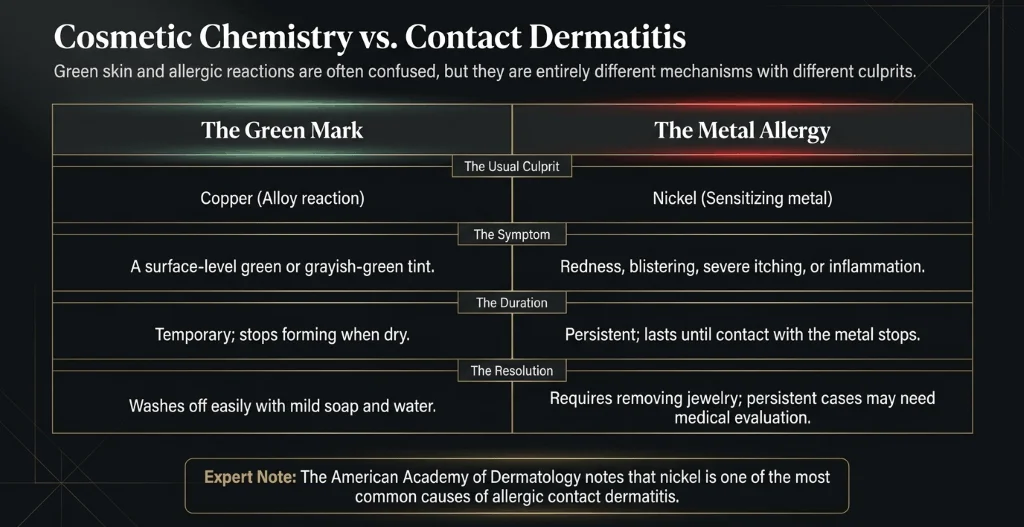
Green discoloration is usually just a surface-level, cosmetic issue. In most cases, it washes off with ordinary soap and water within a day — sometimes within minutes — and leaves no trace once the jewelry and skin are cleaned and dried.
Redness, itching, or a rash is a different story. If you notice swelling, blistering, persistent itching, or significant inflammation — not just a simple green mark — that’s more likely a sign of a possible metal sensitivity than a simple copper reaction, and it’s worth paying attention to rather than ignoring.



Does Real Gold Turn Skin Green?
Real gold itself usually isn’t responsible for green discoloration. A few points worth keeping in mind:
- 24-karat gold is nearly pure gold.
- Jewelry is typically sold as 10, 14, or 18 karat rather than 24 karat, since pure gold is too soft for rings, chains, and bracelets worn every day. If you are looking for durable gold pieces designed for everyday wear, explore our collection of 14K gold jewelry, crafted with quality materials and customizable designs.
- The lower the karat, the higher the percentage of other metals.
- The exact alloy composition matters more than the karat number alone — so karat by itself isn’t a reliable predictor of whether skin will turn green.
Gold Purity and Skin Discoloration
Gold Purity & Alloy Composition
Very Low Reaction Risk
Lower Risk
Depends on Care & Sweat
*The grey area represents alloy metals (like copper or silver) which are typically responsible for skin reactions.
| Gold Type | Approx. Gold Content | Approx. Alloy Metals | Likelihood of Alloy Reaction |
|---|---|---|---|
| 24 karat | 99.9% | Very little | Very low |
| 18 karat | 75% | ~25% | Lower |
| 14 karat | 58.5% | ~41.5% | Depends on alloy composition |
| 10 karat | 41.7% | ~58.3% | Depends on alloy composition |
This table is meant for context only, not a firm guarantee — it isn’t a precise ranking of “which karat turns skin green.” The actual metals in the alloy, and how your skin and habits interact with them, matter just as much as the karat number.
Choosing the right gold jewelry depends on your lifestyle and preferences. Explore our collection of gold necklaces featuring different styles, materials, and customization options.
Gold Jewelry & Skin Reaction Guide
What Makes Skin More Likely to Turn Green from Gold Jewelry?
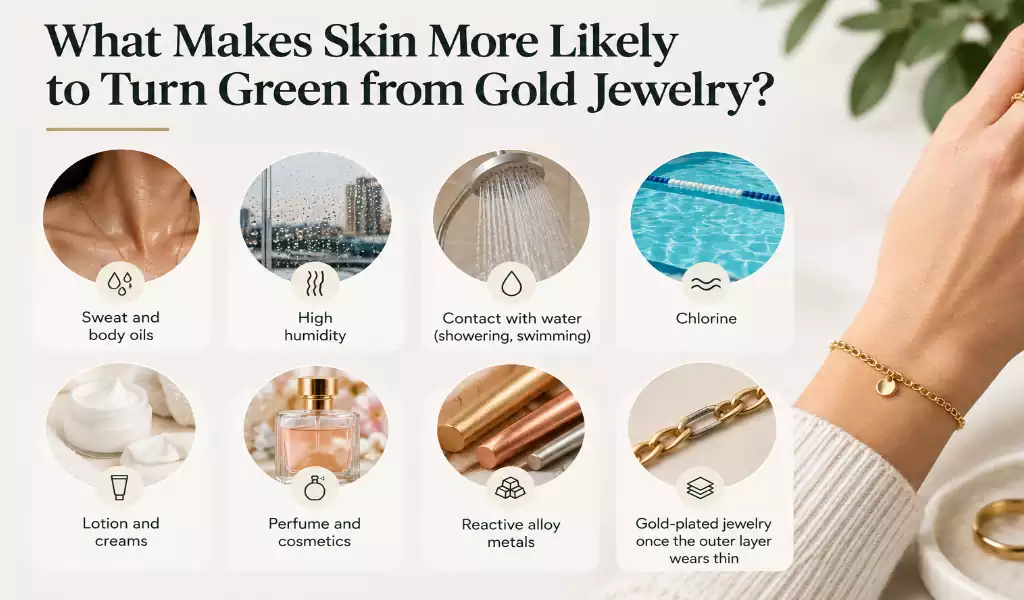
A few everyday factors that tend to make this reaction worse:
- Sweat and body oils
- High humidity
- Contact with water (showering, swimming)
- Chlorine
- Lotion and creams
- Perfume and cosmetics
- Reactive alloy metals
- Gold-plated jewelry once the outer layer wears thin
Does Gold-Plated Jewelry Turn Skin Green?
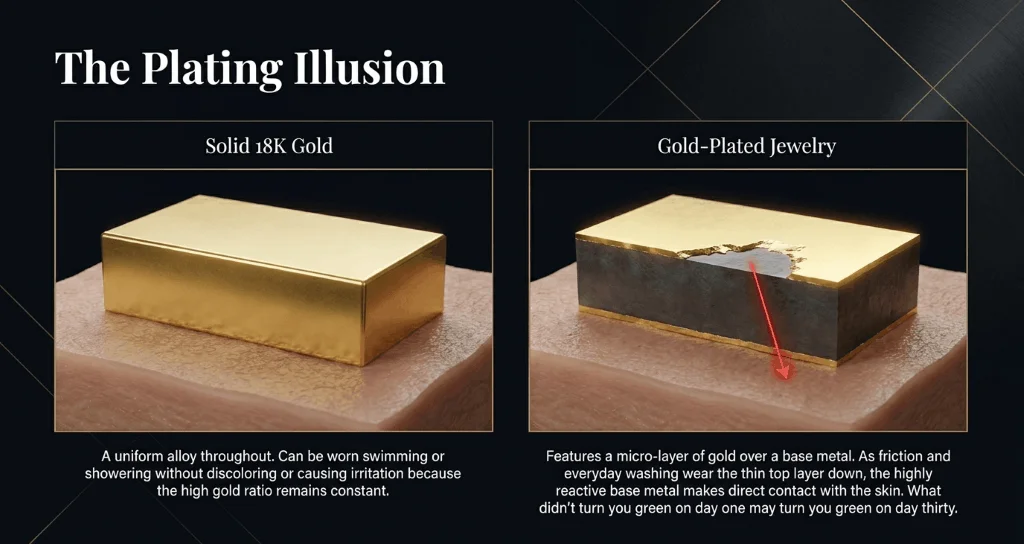
Gold-plated jewelry has a thin layer of gold over a base metal. Understanding the difference between plated and solid materials can help you choose better everyday jewelry. Read more about gold plated vs sterling silver and how each material performs over time.
As that layer wears down from friction and everyday washing, the base metal comes into more direct contact with your skin. If that base metal is reactive, green discoloration becomes more likely — which is part of why gold-plated jewelry can behave differently over time than it did on day one.
If that base metal is reactive, green discoloration becomes more likely. To understand exactly how these layers wear down over time, read our detailed comparison on Gold Plated vs. Solid Gold Jewelry.




How to Prevent Green Skin from Gold Jewelry
🛡️ Prevention Checklist
Simple daily habits can completely stop copper and alloy reactions:
- Keep your jewelry clean and dry.
- Take it off before swimming, showering, or intense exercise.
- Limit direct contact with perfume, lotion, and heavy makeup.
- Dry your jewelry thoroughly after it gets wet.
- If you know you’re sensitive to nickel, specifically choose nickel-free jewelry.
- For anything you plan to wear daily, ask about the alloy composition before you buy.
For a personalized everyday piece, explore our solid gold name necklace collection and learn more about the materials used in custom jewelry.
Simple habits like these were what actually worked for me — it wasn’t about swapping jewelry every few weeks, it was about drying my skin and occasionally giving it a short break.
Why Gold American Jewelry Doesn’t Use Nickel
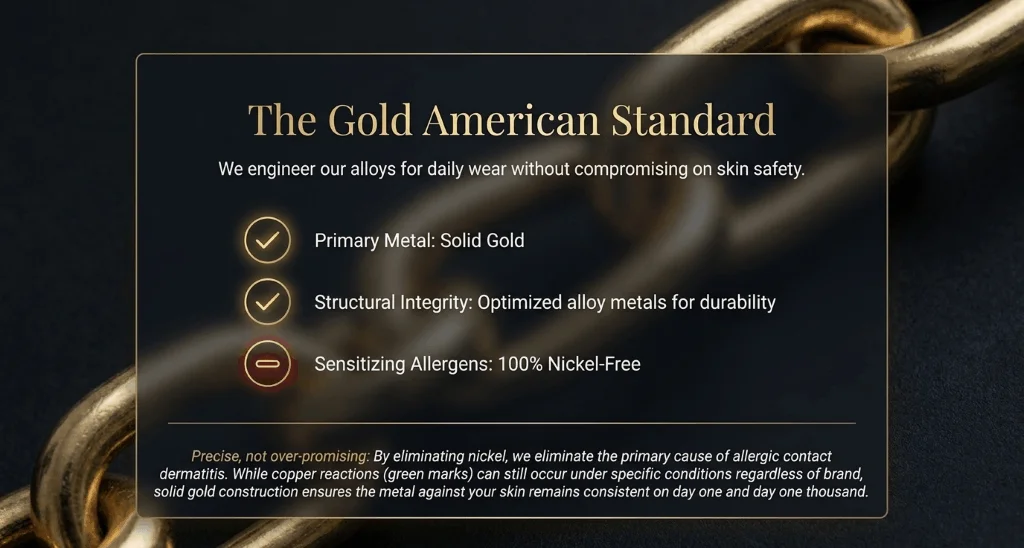
Gold American jewelry is made without nickel. Nickel is one of the metals sometimes used in jewelry alloys, and it’s most closely linked to allergic skin reactions in sensitive individuals. Leaving it out of the alloy makes our products a solid choice for anyone specifically looking for nickel-free gold jewelry.
That said, we’d rather be precise than overpromise: being nickel-free addresses the allergy side of things, not every possible cause of surface discoloration. Copper and other alloy metals can still react with skin under certain conditions, regardless of brand.
| Feature | Gold American | Why It Matters for Skin |
|---|---|---|
| Gold jewelry | Yes | Primary metal in the product |
| Nickel | Nickel-free | Good fit for anyone avoiding nickel in jewelry |
| Karat purity | Varies by product | Worth checking the specific alloy composition |
| Daily wear | Depends on design and care | Both design and upkeep play a role |
| Skin discoloration | No guarantee against it | Depends on alloy composition and conditions of use |
Green Skin vs. Metal Allergy: What’s the Difference?
Green Discoloration
- Appearance: A greenish-grey tint on the skin.
- Cause: Copper or reactive alloys mixing with sweat.
- Sensation: Painless; no itching or redness.
- Solution: Washes off easily with normal soap and water.
Metal Allergy (Dermatitis)
- Appearance: Redness, rash, or slight swelling.
- Cause: Immune reaction to sensitizing metals (like Nickel).
- Sensation: Itchy, uncomfortable, or blistering.
- Solution: Stop wearing the jewelry; may require creams.
- Appearance on skin: Green skin shows up as a green-tinted mark, while a metal allergy causes redness, itching, or inflammation.
- Cause: Green marks usually come from an alloy reaction, especially copper; a metal allergy comes from contact with a sensitizing metal like nickel.
- Duration: Green skin usually isn’t permanent, while a metal allergy can persist until contact with the metal stops.
- Resolves with washing: Green skin usually clears up with simple washing; washing alone is often not enough for a metal allergy.
- Need for medical attention: Green skin usually doesn’t need medical evaluation, while a persistent metal allergy sometimes does.
My Experience With Gold Rings
I had an 18-karat gold ring that was a birthday gift, and I always assumed that because it was gold, nothing could go wrong. But I also bought another ring that was only gold-plated, not solid gold. After about a week, the plating started wearing off and a grayish-green tint appeared underneath. I had no itching or redness — just a mild discoloration that came off temporarily with washing.
That experience taught me that the word “gold” on a label isn’t enough — what matters is whether it’s genuinely solid gold rather than a thin plating. My real 18-karat ring, on the other hand, I wore even while swimming and showering, and it never discolored. If you want a piece you rarely have to take off, investing in authentic Custom Gold Rings is always the safest choice for your skin. So the difference between solid gold and gold plating is really the difference between comfort and hassle.
How to Remove Green Stains from Skin
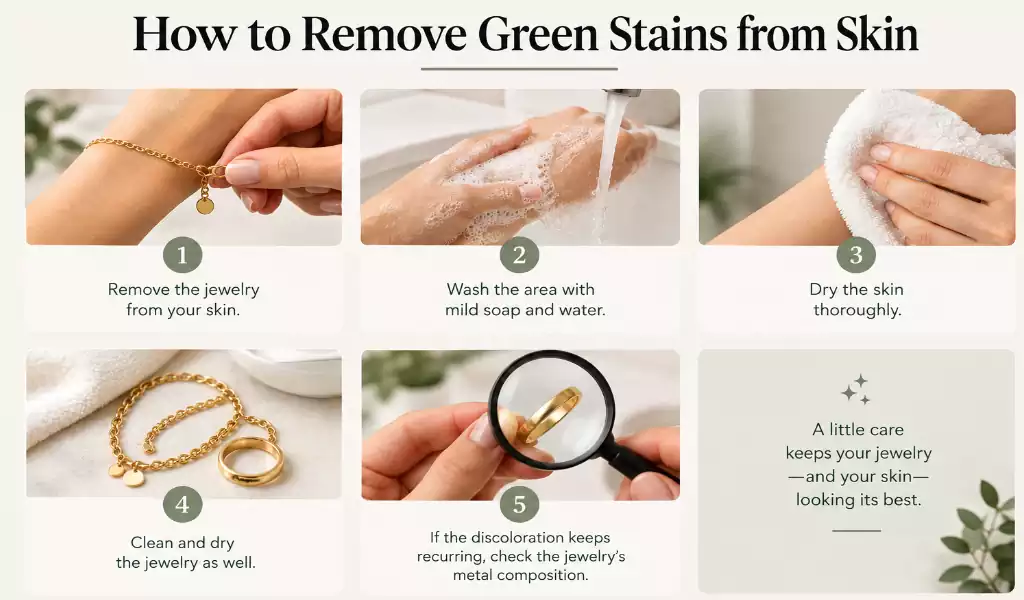
- Remove the jewelry from your skin.
- Wash the area with mild soap and water.
- Dry the skin thoroughly.
- Clean and dry the jewelry as well.
- If the discoloration keeps recurring, check the jewelry’s metal composition.
Avoid anything abrasive or acidic on your skin to try to speed this up — it’s not only unnecessary, it can further irritate skin that’s already reacting.
Looking for Gold Jewelry That Fits Your Lifestyle?
Choosing the right gold jewelry starts with understanding materials, alloys, and everyday wear. Explore our handcrafted gold pieces designed with quality materials and customizable options.
Need help choosing? Call us:
+1 (888) 970 2242
Gold Jewelry and Green Skin FAQs
1. Why does gold jewelry turn my skin green?
Usually because of copper or other reactive metals in the gold alloy reacting with sweat, moisture, or substances on your skin — not the gold itself.
2. Does real gold turn skin green?
Usually not. This reaction almost always comes from the other metals mixed with the gold, not from pure gold.
3. Does 14-karat gold turn skin green?
It can, depending on the specific alloy. 14-karat gold has a larger share of other metals than 18 or 24 karat, so the alloy composition matters more than the karat number alone.
4. Does 18-karat gold turn skin green?
It’s less likely than lower karats since it contains more pure gold, but it’s not impossible — it still depends on the remaining metals in the alloy.
5. Can nickel turn skin green?
Usually not. Nickel is more associated with allergic skin reactions like redness and itching than with green discoloration. If you experience itching, redness, or irritation from jewelry, learn more about possible reactions in our Gold and Allergy guide.
6. Does Gold American jewelry contain nickel?
No. Gold American jewelry is made without nickel, making it a good fit for anyone specifically looking to avoid nickel in their jewelry.
